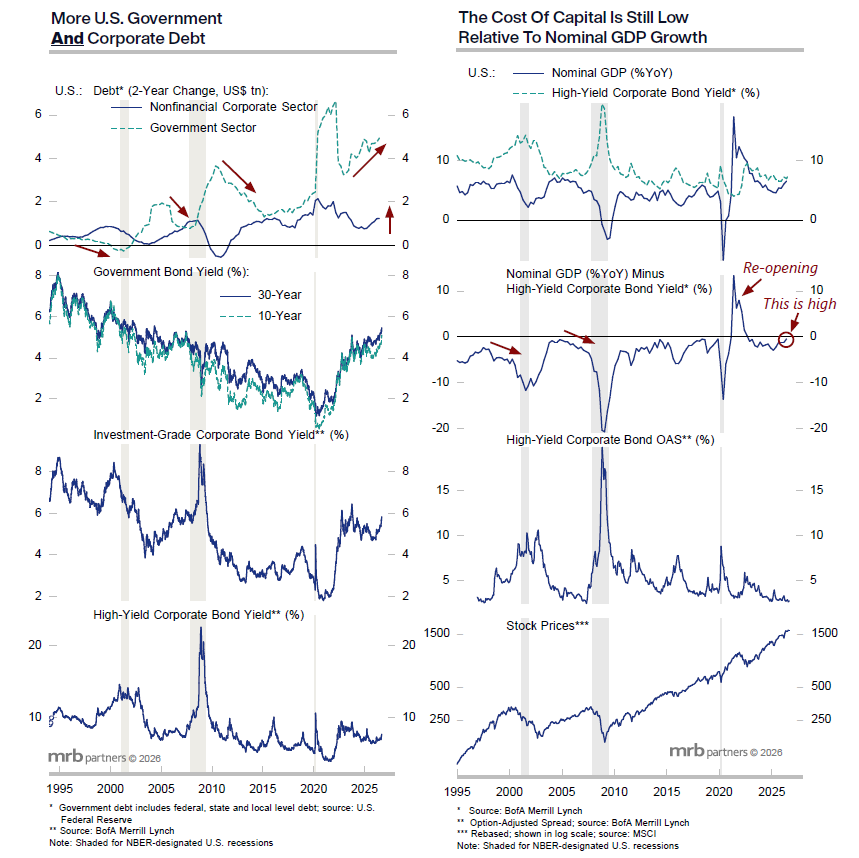
Bond markets perform poorly when the demand for credit exceeds the supply, as higher rates are needed to attract sufficient capital. The current backdrop in the developed world is witnessing a bout of “crowding out”, especially in the U.S.
A just-published report examined the fundamentals behind the rout in government bond markets, which has intensified as growth, inflation and booming credit demand, along with lagging central banks, have combined to create a perfect storm. Government budget deficits normally shrink when growth is above the economy’s long-run potential, but that has not been the case this decade. The surge in borrowing to sustain the A.I. boom this year is adding to already strong government bond issuance, intensifying the upward pressure on bond yields.
Economic activity only turns south when the cost of capital exceeds the return on capital. Our research shows that much of the developed world, especially the U.S., has not yet reached that point. The canaries that typically warn of recession (and, thus, approaching bond bull market) are still chirping.
Net: while bonds are now oversold, the cyclical outlook is still bearish.